.png)
What We Reach for When We Need Safety
- Eden Mabry
- May 30
- 9 min read


Most people do not realize they are already carrying a map of their nervous system.
That map can be seen in their patterns, their habits, their relationships, and the ways they cope when life becomes overwhelming. It often reveals itself in the moments we least expect—when we are stressed, hurt, afraid, disappointed, lonely, or uncertain about what comes next.
The question is not whether we seek safety. Every human being does. The real question is this: What have we learned to reach for when we need it?
A Blue Ball, a Broom, and a Two-Year-Old
A few minutes ago, my two-year-old son was playing with a small blue wiffle ball. We were tossing it back and forth when it rolled underneath the couch. He immediately dropped to the floor and tried to reach for it, but he couldn’t. The space beneath the couch was too small. The ball was visible, but it was completely out of reach.
I asked him to come sit beside me and pointed underneath the couch so he could see exactly where the ball was. The problem was no longer that the ball was missing. We both knew where it was. The problem was that he could not access it.
I walked into the next room and grabbed a broom. He had never used a broom for this purpose before, but I handed it to him and allowed him to experiment. Immediately, he began trying to use it. He understood that it was long. He understood that it could move things. What he did not yet understand was how to use it effectively.
So I guided him.
While he held the broom, I looked underneath the couch and gave simple directions. I told him to move it forward, then backward, then to the left. At first, the ball actually moved farther away from where he wanted it to go. Yet with continued guidance, the ball slowly moved toward a place where he could eventually reach it himself. A few moments later, it rolled out from beneath the coffee table, and he happily crawled over and picked it up.
At that moment, I realized something important. The ball was no longer the lesson. The process had become the lesson.
Later, I found myself thinking about
Psalm 32:8: I will instruct you and teach you in the way you should go; I will counsel you with My loving eye on you.
That verse would stay with me long after the ball had been retrieved.
Why We Often Resist the Tools We Need
As I watched my son, I couldn’t help but think about how often this happens in our own lives.
How often does God work the same way in our own lives? We pray for answers, relief, and immediate solutions, yet many times God provides wisdom, instruction, and guidance instead. He does not always remove the obstacle in front of us, but He promises to walk with us, teach us, and direct us as we learn to navigate it.
Perhaps the greatest lesson that day was not about retrieving a ball from beneath a couch. Perhaps it was learning that guidance often arrives before the solution.
The challenge is that having a tool, knowing how to use it, and the wellness to accept guidance are not the same thing. Like my son holding the broom, we often receive exactly what we need without fully understanding how to use it. We want immediate relief, but what we frequently receive is guidance. We want certainty, but instead we are invited into a process. The question then becomes whether we are willing to trust the guidance long enough to learn.
The Problem Beneath the Problem
After my son retrieved the ball, something unexpected happened. The broom suddenly became more valuable than the ball itself.
He wanted to continue playing with it. When I eventually took the broom away, he became frustrated. He stomped his foot, yelled, and expressed his disappointment very clearly.
At first glance, it would have been easy to conclude that the problem was his behavior. Many adults stop there. We see the behavior and immediately begin thinking about consequences, corrections, or ways to make the behavior stop.
But behavior should be the first place to spark curiosity to examine a more meaningful question. What is this behavior trying to accomplish?
When I looked beyond the stomping and frustration, I realized that my son had found value in something and now it was gone. His frustration made sense. The behavior was not random. It was communicating an experience.
That simple shift in perspective changes everything. Instead of asking, “How do I stop this behavior?” we begin asking, “What is this behavior trying to tell me?”
Sometimes behavior is not simply revealing what a person is doing. It is revealing what they have learned, what they have experienced, and what they have learned to reach for when they need safety.
What Attachment, Trauma, and Behavior Have in Common
This is where attachment theory, trauma research, and behavior analysis begin to intersect in a fascinating way.
For a toddler, safety may be found in a blanket, a pacifier, or a favorite stuffed animal. For an adult, it may be found in food, work, achievement, social media, alcohol, isolation, or countless other coping strategies. For others, safety may be found in prayer, worship, Scripture, trusted relationships, or supportive community.
The object itself is often the surface issue. However, a more important question is what that object, behavior, or relationship has become associated with over time.
Through repeated experiences, our brains learn what seems to bring relief. We learn what helps us feel calm, connected, protected, or in control. Those experiences gradually become habits, and habits eventually become pathways. Over time, those pathways can become so familiar and comforting that we stop questioning them altogether.
The more often these pathways are practiced, the more automatic they can begin to feel.
Why Emotional Patterns Feel So Automatic
If these patterns are learned over time, it raises an important question. Why do they often feel so automatic?
Many people assume they are simply reacting to life as it happens. They believe their responses are spontaneous, unpredictable, or entirely dependent on the situation in front of them. However, when we look a little closer, we often discover that many of our reactions have been practiced far more than we realize.
Consider a child who is repeatedly comforted by the same blanket.
Over time, that blanket may become associated with safety, comfort, and relief. The blanket itself does not create safety, but through repeated experiences it becomes connected to the feeling of being safe.
Adults often develop similar patterns, although they may look very different on the surface. A person who repeatedly turns to alcohol after experiencing rejection may gradually begin associating alcohol with relief. Another person may turn to work, food, isolation, achievement, social media, or countless other coping strategies. The specific behavior may differ, but the learning process is often remarkably similar.
It is important to understand that the object, activity, or coping strategy does not necessarily create the underlying attachment pattern. Rather, repeated use can strengthen the beliefs and coping strategies already connected to that pattern.
For example, a person who carries a belief that they must handle everything alone may repeatedly seek relief through isolation. Each time isolation temporarily reduces discomfort, the belief appears to be reinforced. The nervous system learns that this pathway feels familiar and predictable. Over time, the pathway becomes increasingly well-worn.
This process often follows a cycle that many people never consciously notice.
An experience occurs.
That experience activates a belief.
The belief influences behavior.
The behavior provides relief.
The relief strengthens the belief.
Then the cycle begins again.
The more often the cycle repeats, the more automatic it can feel. Eventually, the pathway becomes so familiar that it no longer feels like a choice. It simply feels like reality.
This is one reason emotional patterns can be so difficult to recognize. Familiar pathways often feel true simply because we have traveled them so many times.
Yet familiarity and truth are not always the same thing.
A familiar pathway may have helped us survive a difficult season, but survival and growth are not always the same thing. Familiarity alone does not determine whether a pathway is still helping us move forward.
Sometimes the most important step in healing is realizing that a familiar path is not the only path available.
The Hidden Influence of Emotional Contagion
As we begin looking at the patterns we reach for when we need safety, it is important to recognize that we do not learn these patterns in isolation. Human beings are designed for connection, and whether we realize it or not, we are constantly influencing one another.
Researchers have studied this phenomenon through concepts such as emotional contagion, social learning, and nervous system regulation. While the terminology may differ, the underlying principle is remarkably similar. Human beings continuously gather information from the people around them. We pay attention to facial expressions, tone of voice, body language, posture, breathing patterns, movement, and countless other signals. Much of this happens outside of conscious awareness.
This helps explain why children often sense when something feels “off” before a parent says a single word. It explains why tension can spread through an entire room, why calm leaders often create calm environments, and why one highly dysregulated person can impact an entire group. Our nervous systems are constantly gathering information and adjusting accordingly.
Perhaps this is why a child can ask, “Are you okay?” when a parent has said nothing at all. The child may not know exactly what is wrong, but they recognize that something has changed. The nervous system notices what words often miss.
Human beings were never designed to function completely alone. We influence one another continuously. Sometimes we spread anxiety. Sometimes we spread peace. Sometimes we spread fear. Sometimes we spread courage. Whether we are aware of it or not, our nervous systems are constantly participating in a larger conversation.
The same relationships that help shape our patterns can also help reshape them.
When Awareness Becomes Wisdom
Understanding our patterns is not about judging ourselves. It is not about labeling every habit as good or bad. The goal is not to eliminate patterns altogether. The goal is to recognize them.
Many of us spend years following the same pathways without realizing we are doing it. We experience stress, and we automatically reach for something familiar. We experience loneliness, and we automatically respond in a predictable way. We experience rejection, disappointment, uncertainty, or fear, and before we even realize it, we are following a well-worn path our nervous system has traveled many times before.
Awareness changes that.
The moment a pattern becomes visible, we gain the opportunity to interrupt it. Instead of automatically following the same route, we can begin asking different questions.
What am I reaching for right now?
Why am I reaching for it?
What need am I trying to meet?
Is there another path available?
These questions are not meant to produce guilt. They are meant to produce curiosity.
Growth does not begin when a pattern disappears. Growth begins when a pattern becomes visible enough for us to recognize it. The moment we can see the path we are walking, we gain the ability to choose whether we want to continue walking it.
This is where awareness gradually becomes wisdom.
The Gift of a Different Path
One of the most encouraging truths found throughout psychology, neuroscience, attachment theory, behavior analysis, and faith is that patterns can change.
Behavior analysis might describe this as developing a replacement behavior. Neuroscience often refers to it as neuroplasticity. Attachment theory speaks of corrective relational experiences. Faith frequently describes it as transformation.
Although the language is different, the message is remarkably similar.
A pattern learned can also be changed.
This does not happen instantly. It does not happen through shame, fear, or force. Most lasting change occurs through awareness, guidance, practice, and repetition.
The same way a path becomes worn from walking it repeatedly, a new path becomes stronger when we choose it consistently.
At first, the new path often feels unfamiliar. It may even feel uncomfortable. The old path feels easier because it is familiar, even when it no longer serves us well. Yet every time we choose a healthier response, every time we practice a new skill, every time we allow ourselves to trust a safe relationship, and every time we choose a different way of coping, we strengthen a new pathway.
Over time, what once felt impossible begins to feel natural. The goal is not perfection. The goal is practice.
A Final Thought
Perhaps growth is not about having all the answers. Perhaps growth is about learning to recognize the patterns we have followed for years and choosing a different path when they appear.
Just because a pathway is familiar does not mean it is permanent. Just because a coping strategy once provided relief does not mean it must define our future. Just because a pattern helped us survive does not mean it is the only path available moving forward.
Life will continue to bring challenges. We will all experience disappointment, uncertainty, grief, fear, frustration, and moments when we desperately want relief. The question is not whether we will reach for something when life becomes difficult.
We all will.
The question is what we are reaching for and where that path is leading us?
If these questions resonate with you, then perhaps you are already beginning to connect some of the dots in your own story.
The goal of this article was never to tell you what to think or to diagnose your patterns for you. Instead, it was to invite you to become curious about the pathways you have learned, the beliefs that have shaped them, and the places you turn when life feels uncertain, overwhelming, or painful.
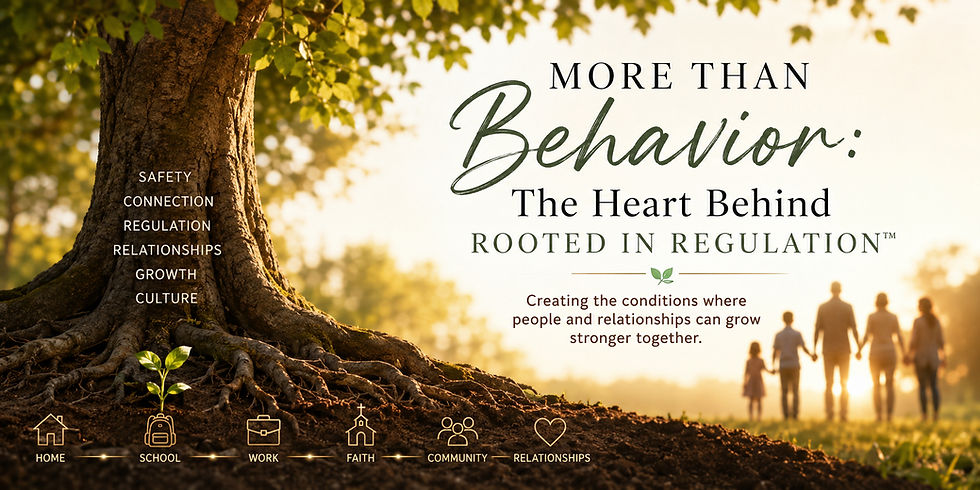
These are the very questions explored throughout Rooted in Regulation™: Where the Brain, Body, Spirit, and Relationships Connect. Through stories, science, faith, nervous system regulation, attachment, and practical application, the book is designed to help readers recognize their patterns, understand where those patterns may have come from, and discover healthier pathways forward.
Because change rarely begins with behavior alone.
Change begins with awareness.
Awareness reveals the pattern.
Relationship provides safety.
Safety allows for learning and making mistakes.
Practice creates a new pathway.
Repetition strengthens it.
And over time, what once felt automatic no longer has to define your future.


Comments