.png)
From Protection to Growth: An Invitation to Connection—for You and Your Child


Written by
Eden Mabry, M.Ed
Neuro-Behavioral & Family Systems Practitioner
Founder, Quality Behavioral Coaching
Integrating nervous system science, attachment, and faith-rooted connection for families.
A moment I didn’t slow down for
It was one of those moments that felt small — until it wasn’t.
The cup tipped.
Water spilled across the table and onto the floor.
And I reacted the way most parents do.
I didn’t pause.
I didn’t breathe.
I didn’t soften my voice.
I said their name — that familiar tone — and immediately moved into action.
I grabbed paper towels.
I wiped the table.
I finished the task.
I kept going.
The schedule didn’t stop.
Dinner still needed to happen.
The next thing still mattered.
On the outside, I thought I looked regulated, Capable, Functional. Yes, the mess was handled. The boxes were checked for the moment. Yes, somethings were off my plate.
But the stress and demeanor from those boxes being checked followed me into the moments to come.
I could feel it trailing behind me — quiet, unresolved — as we moved into the next task and then the next. And later, after the kids went to bed, the kitchen was clean, and I finally was in a moment of stillness, I could finally see it clearly.
As I was reflecting, I felt like I was a fly on the wall watching myself in these fast paced- rushed moments. Overwhelmed with heavy feelings that felt like burdens, communicated to my children through my spirit that I was not regulated, capable of having the capacity for peace or calm in unplanned moments. Demonstrating that I most certainly was not functioning from a place of love.
Yes, the water had been cleaned up.
But connection had been lost.
Something in my child had tightened. Something that spoke “brace yourself”.
Something in me had moved away.
No one yelled.
No one melted down.
But spirits had been bruised.
And that’s when it hit me.
That moment — the spill, the pause I didn’t take, the tone I used — it could have been something else!
It could have been an invitation.
Not an invitation to fix or lecture or move faster.
But an invitation to come together.
To slow down.
To solve the problem or meet the need, as a team.
To build something stronger than what existed before the mistake.
And once I saw that, I couldn’t unsee it.
Being skilled doesn’t make us less human
What this moment showed me was something important.
No matter how trained I am.
No matter how much I know.
No matter how many tools I’ve learned, taught, or practiced.
I am still human.
I will still miss moments.
I will still react instead of respond.
I will still say something in a tone I didn’t mean to use.
Because we are not meant to be perfect.
Just as sin separates us from God, moments of disconnection can separate us from one another — from our children, from ourselves. Not because we’re “bad” parents, but because we’re human and limited and still learning.
But here’s the part that changed everything for me:
Separation does not have to be the end of the story.
It can be the place where repair begins.
When we recognize what happened…
When we take responsibility — not with shame, but with honesty…
When we say, “That didn’t land the way I wanted it to, and I want to try again,”
we open the door back to connection.
Repair isn’t just saying “sorry.”
It’s saying, “I see it now.”
It’s saying, “I’m willing to do something a little differently next time.”
Not because we promise perfection — but because we’re willing to stay present.
And every time we do that, we model something sacred.
We model:
what responsibility looks like
what accountability looks like
what forgiveness looks like
what repentance looks like
what connection after dysregulation can look like
what grace and mercy feel like in real life
Not in theory.
In relationship.
This is how God relates to us
This realization brought me back to something deeper.
God does not wait for us to be regulated, articulate, or composed before drawing near.
He meets us in the mess.
He sits with us in the mud.
He doesn’t rush to remove the discomfort or immediately solve the problem.
Instead, He stays.
He equips us — not just with a way out, but with the wisdom to recognize how we got there, and how we might walk differently next time.
Not through shame.
Through communion.
And if this is how God relates to us, then maybe parenting was never meant to be about getting it right — but about learning how to return.
Why behavior isn’t the problem
So often, we’re taught to treat behavior as the issue to fix.
But behavior is not the source.
It’s the signal.
Children — just like adults — move through different nervous system states throughout the day. In some moments, they are open and connected. In others, they are overwhelmed and protecting themselves.
This isn’t defiance.
It isn’t a parenting failure.
It’s what bodies do when they feel unsafe or overloaded.
Growth doesn’t happen through pressure.
It happens through access.
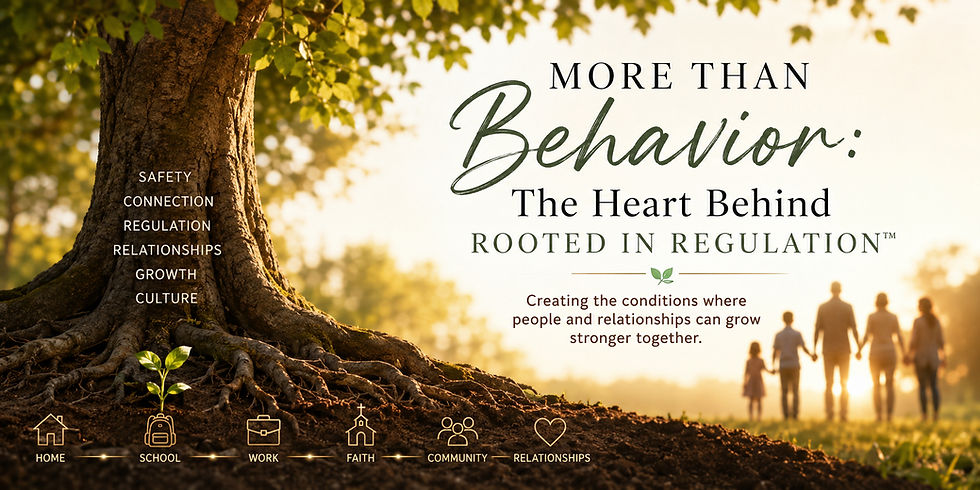
The Rooted Regulation™ invitation
In the Rooted Regulation™ model, we understand growth as a pathway:
Body → Relationship → Meaning
When the body feels safe, relationship becomes possible.
When relationship is steady, learning and reflection can occur.
This is true for children.
And it’s true for parents too.
When protection takes over, our role is not to teach — but to stay.
When connection begins to return, our role is not to correct — but to repair.
When regulation is restored, growth can finally take root.
This is not permissiveness.
It’s formation.
A Pocket Guide for Hard Moments
Something to hold onto when things feel heavy
🟥 When Protection Takes Over
There are moments when your child’s behavior feels big, confusing, or intense.
There are also moments when you feel the same way inside.
In these moments, nothing needs to be fixed right away.
This is where God models something powerful:
He stays.
For parents, this might sound like:
“I’m here.”
“We’ll get through this.”
“You don’t have to calm down alone.”
These words aren’t strategies.
They are signals of safety.
🟨 When Connection Begins to Return
As things soften — even just a little — trust is quietly rebuilt.
This is where repair happens naturally, not forcefully.
No rush. No pressure.
You might say:
“That was really hard.”
“I’m still with you.”
“We can take our time.”
This is communion —
being with one another without needing answers yet.
🟩 When Growth Becomes Possible
Only after safety is felt does learning begin to stick.
This is where reflection, skill-building, and teaching belong — not earlier.
And even here, growth is not about perfection.
It’s about shared understanding.
This Is Not About Doing It Right
It’s important to hear this clearly:
Your child’s struggles are not evidence that you’re doing something wrong.
They are invitations — moments where connection can grow stronger over time.
The same invitation God extends to us:
without shame
without urgency
without condemnation
is the invitation we can slowly learn to extend
to ourselves
and to our children.
A closing line you can repeat to parents (or yourself)
“Nothing is ruined. We can come back.”
A Word for the Parent Reading This
If today feels messy, you are not behind.
If regulation feels hard, you are not failing.
If connection feels distant, it is not gone.
Presence is enough to begin.
God meets us in our most unfinished moments —
and teaches us how to meet our children there too.
That is not correction.
That is communion.
And it is always an invitation.
A closing line you can repeat to yourself
“Nothing is ruined. We can come back.”
If something in this reflection felt familiar, that’s worth honoring.
I’ve created a printable visual to go with this post — a simple tool parents can keep close when connection feels hard. It’s available through the QBC email list, where I share reflections, resources, and invitations connected to each blog and event.
You’re also welcome to comment below or follow along if this feels like a place you’d like to return to.
There’s no rush.
No pressure.
Just an open invitation to stay connected.


Comments